If you're in the TTC phase (trying to conceive), you already know how quickly things can start to feel overwhelming. You’re tracking your cycle, paying attention to what you eat, trying to reduce stress, and still wondering if you’re missing something.
That’s usually where the question comes in. Does seed cycling work? Or is it just another trend?
Here’s the thing. Fertility is not just about one day in your cycle. It’s about how well your hormones are supported throughout the month. When estrogen and progesterone are not balanced, ovulation can be inconsistent, and that can make conceiving harder than it needs to be.
This is where seed cycling for fertility comes in. It’s a simple, food-based approach that uses everyday seeds like flax, pumpkin, sesame, and sunflower, timed across different phases of your cycle to support hormonal balance.
In this guide, we’ll break down the real seed cycling benefits, how it supports fertility, and exactly how to do seed cycling in a way that actually fits into your daily life.
What Is Seed Cycling?
Seed cycling is a simple, food-based approach that supports your hormones by aligning what you eat with your menstrual cycle. Instead of overhauling your diet, you’re adding specific seeds at specific times to help your body stay balanced.

Here’s how the 2-phase system works:
-
Follicular phase (Days 1–14): flaxseeds + pumpkin seeds
-
Luteal phase (Days 15–28): sesame seeds + sunflower seeds
Each seed provides nutrients that support estrogen and progesterone balance
If you’re wondering how to do seed cycling, it’s actually very doable in real life:
-
Add 1–2 tablespoons of seeds daily
-
Mix into smoothies, curd, oats, or salads
-
Switch seeds based on your cycle phase
-
Stay consistent for at least 2–3 cycles
The idea is simple. You’re not forcing your body to change. You’re supporting it with the right nutrients at the right time.
Let’s First Ask: How Do Hormones Affect Fertility?
Fertility depends on how well your hormones work together across your entire cycle. Two key hormones are estrogen and progesterone, and both need to be in sync.
Here’s what happens through your cycle:
-
Estrogen (first half): helps mature the egg and triggers ovulation
-
Ovulation: the egg is released and fertility is at its peak
-
Progesterone (second half): supports the uterine lining for implantation
-
Luteal phase: critical for sustaining early pregnancy
If this balance is off, it can impact fertility in multiple ways:
-
Irregular ovulation
-
Short or weak luteal phase
-
Difficulty with implantation
Seed cycling supports this by aligning nutrients with each phase. Over time, this can help create a more stable hormonal environment, which is essential for conception.
How Seed Cycling Supports Fertility
Seed cycling supports fertility by giving your body the right nutrients at the right time in your cycle. Each seed used in this approach is rich in compounds that directly influence hormone production and balance.
Here’s what makes it effective:
-
Flaxseeds → rich in lignans that support healthy estrogen levels
-
Pumpkin seeds → high in zinc, which plays a role in ovulation and hormone regulation
-
Sesame seeds → help modulate excess estrogen in the luteal phase
-
Sunflower seeds → contain selenium and vitamin E, supporting progesterone production
These nutrients work together to create a more stable hormonal environment, which is essential for fertility. Seed cycling is designed to support estrogen in the first half of the cycle and progesterone in the second, helping your body stay in rhythm.
Some of the key seed cycling benefits include:
-
More regular menstrual cycles
-
Improved ovulation consistency
-
Reduced PMS symptoms
-
Better overall hormonal balance
Over time, this consistent support can make your cycle more predictable, which is a key step when you’re trying to conceive.
Does Seed Cycling Actually Work?
Let’s address the obvious question. Does seed cycling really work?
Short answer: it’s not magic, but it’s not meaningless either.
Scientifically, research on seed cycling is still limited, with few large-scale studies proving direct results. But early evidence and case reports suggest it supports hormonal balance and improves symptoms linked to irregular cycles and PCOS.
It’s a low-risk, food-based approach that supports hormones indirectly and helps build consistency in your routine.
The key is expectation. Seed cycling is not a quick fix. It works gradually, especially when combined with good sleep, stress management, and a balanced diet.
So, does seed cycling work? For many women, yes, as a supportive tool. Not as a shortcut, but as part of a consistent approach to hormone health.
Making Seed Cycling Actually Easy to Stick To
The hardest part isn’t knowing what to do. It’s doing it every single day.
Here’s how to make it convenient.
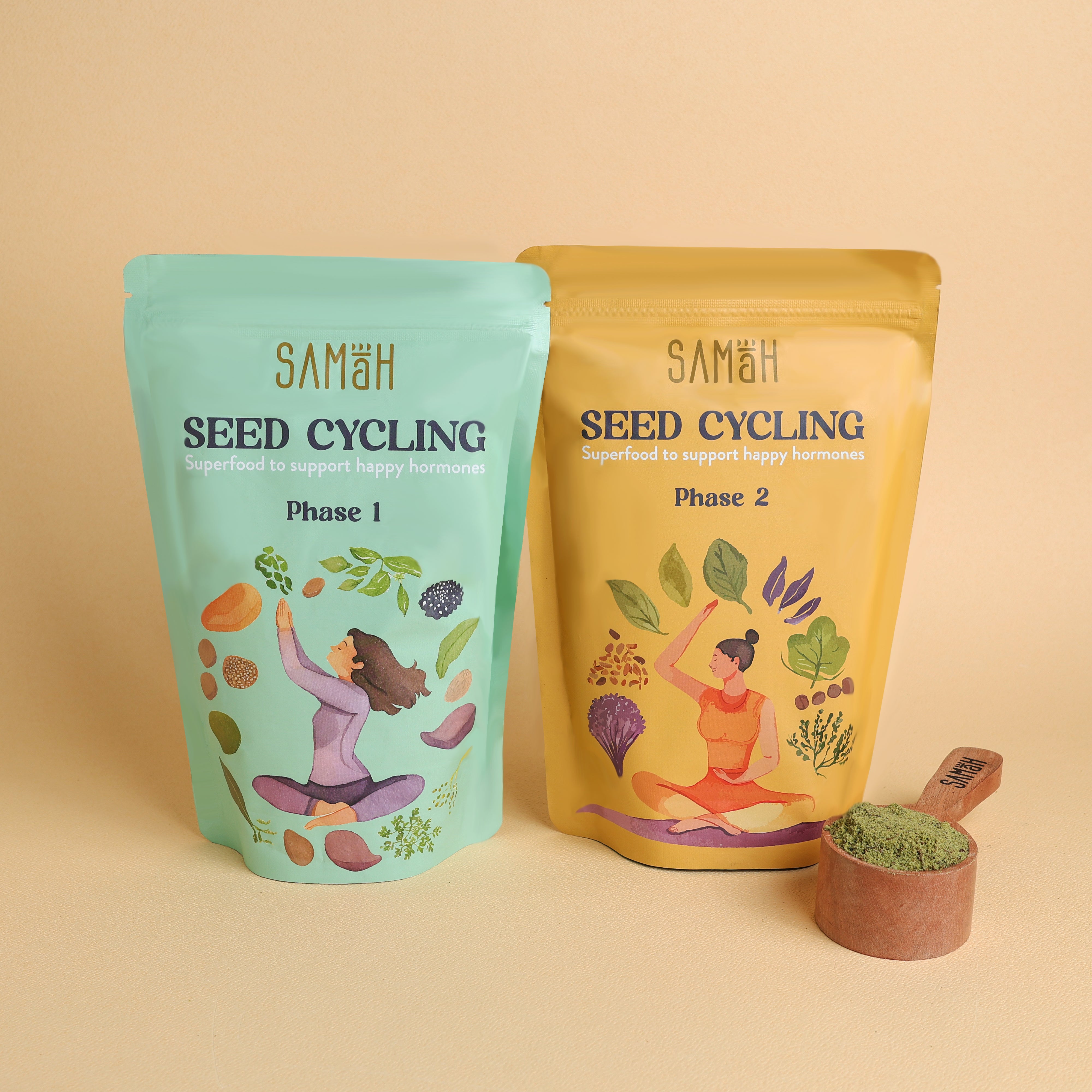
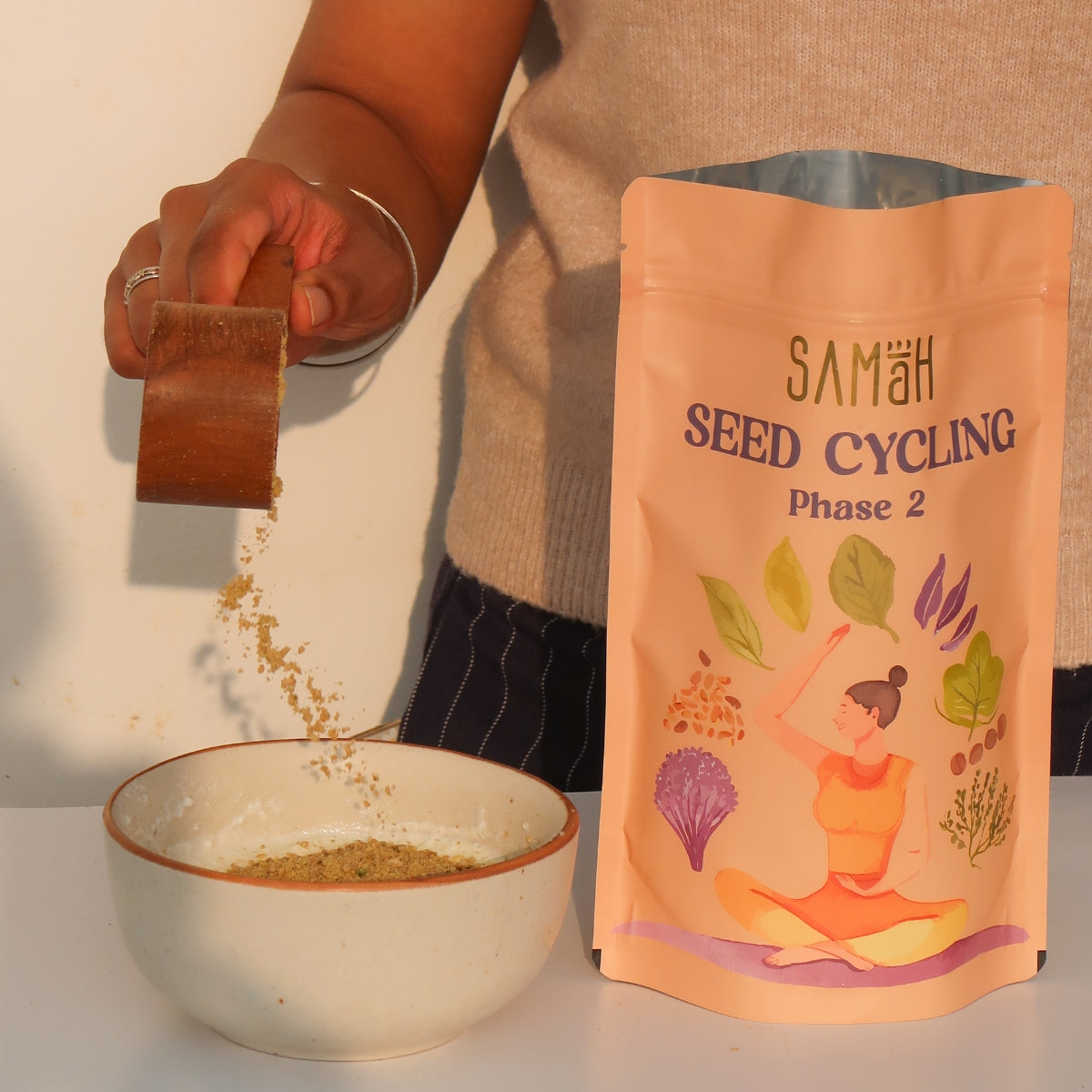
You could definitely go with buying, measuring, and remembering which seeds to take. Or you could get a seed cycling kit that simplifies everything. With Samāh’s seed cycling kit, the seeds are already cleaned, balanced, and portioned for each phase. You just take it and add it to your food. No guesswork, no tracking confusion.

What’s in each phase:
-
Phase 1 (Follicular): flax seeds + pumpkin seeds → support estrogen and ovulation
-
Phase 2 (Luteal): sesame seeds + sunflower seeds → support progesterone and implantation
How to take it:
-
1–2 tablespoons daily
-
Add to smoothies, curd, oats, or meals
-
Switch blends based on your cycle phase
There’s also a variant of our Seed Cycling Blend with chamomile, which adds a gentle calming effect. This can be especially helpful in the luteal phase when stress and sleep can impact your cycle.
What to Expect (Realistically)
WEEK 1–2
Your body adjusts
You’re introducing new nutrients. Some women notice better digestion from the fibre. Others notice nothing yet. Both are normal.
MONTH 1
Subtle shifts begin
Energy may feel more stable. Bloating can reduce slightly. Your body is starting to absorb key nutrients like zinc and essential fats.
MONTH 2
Changes become noticeable
This is where things pick up. Many women report lighter PMS, fewer cramps, clearer skin, and more predictable mood patterns.
CYCLE 3+
The compounding effect
Your body has now gone through multiple supported cycles. This is when people say their cycle feels smoother, more regular, and easier to manage.
LONG TERM
A daily practice
Seed cycling is not a quick fix. It’s something you continue because it works with your body, not against it.
Individual results vary. Seed cycling is nutritional support, not medicine.
Fertility is tricky because you can seemingly be doing “everything correctly” and still face issues. But regardless of your routine and health, it’s important to support your body in a way that’s consistent and sustainable. Seed cycling works because it fits into real life. It uses simple, everyday foods to support your hormones across your cycle, helping create a more stable environment for ovulation and overall reproductive health
Over time, these small, consistent inputs can add up. Many women notice smoother cycles, better energy, and improved hormonal balance when they stick with it. It’s not a quick fix, but a steady, food-based approach that works with your body’s natural rhythm, not against it
Try the Samāh Seed Cycling Blend today!